Case I
A Short History of Games of Chance
The grand tour: how humanity turned accident into play, play into ritual, and ritual into mathematics. Start here for the whole map.
Open drawerA sponsor-free cultural archive · est. 2026
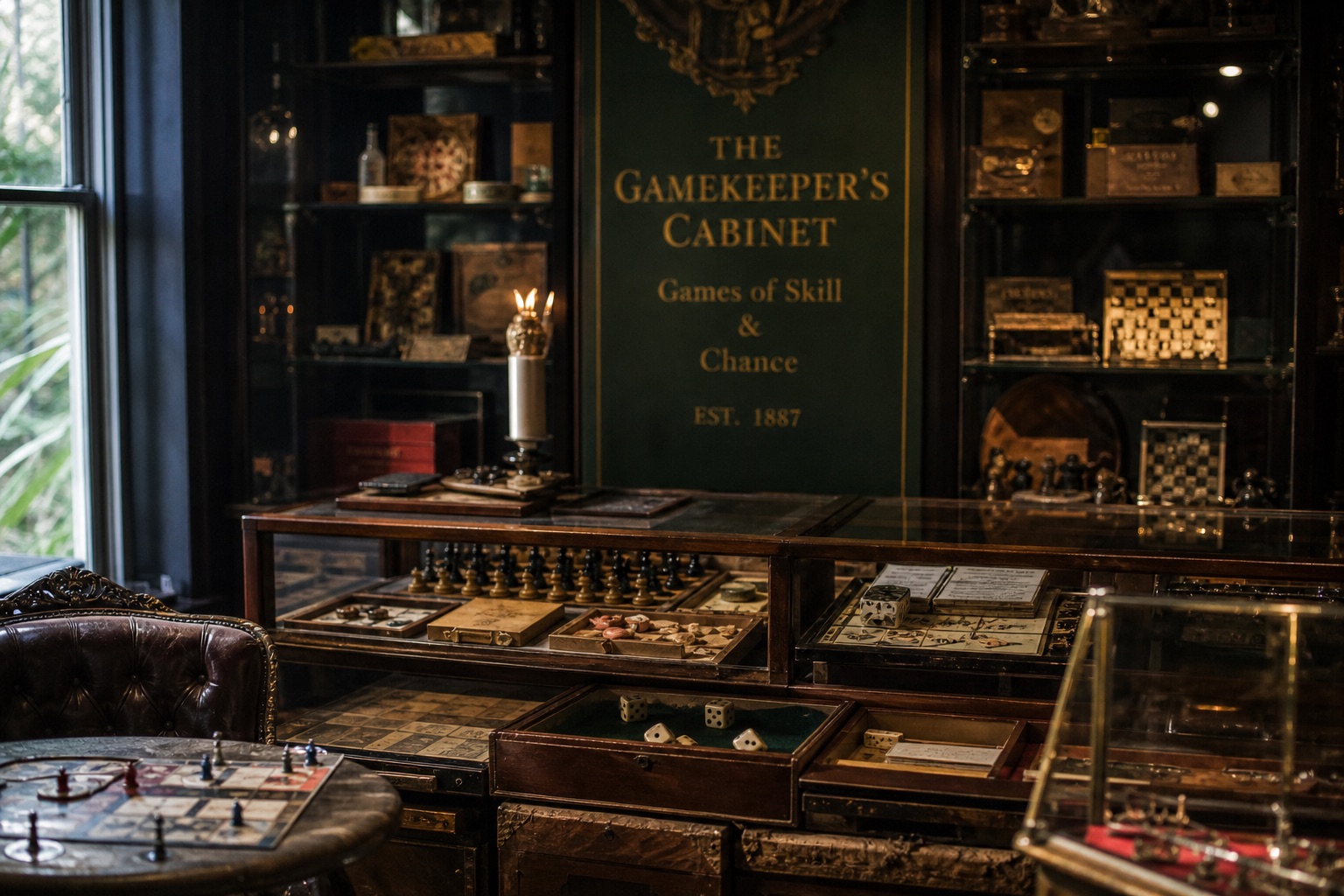
Five thousand years ago, someone in Mesopotamia carved a board and cast knucklebones to move pieces across it. From those ankle bones of sheep came dice, cards, lotteries, roulette wheels, and, eventually, the mathematics of probability itself. This archive gathers that long story in one quiet room.
The collection is encyclopedic in tone and non-commercial by charter: fifteen reference drawers covering the archaeology of play, the journey of the card from Tang China to the courts of Europe, the invention of fortune-telling from a duke’s card game, and the letter of 1654 in which two mathematicians finally taught luck to count. Every drawer cross-references its neighbours, so the cabinet can be wandered, not just searched.
Enter the archive What this cabinet is Chance in the artsFifteen drawers, each devoted to one branch of the history of games of chance and skill (from Sumerian boards to the theorem of Jacob Bernoulli).
Case I
The grand tour: how humanity turned accident into play, play into ritual, and ritual into mathematics. Start here for the whole map.
Open drawerCase II
Astragali in Egyptian tombs, Roman dice towers, Viking whalebone cubes (the oldest random-number generators ever made).
Open drawerCase III
From Tang-dynasty “leaf games” through Mamluk Egypt to the four French suits that conquered the world in 1377.
Open drawerCase IV
A Paris parlour device of the 18th century, a Baden health resort, and the single zero that built Monte-Carlo.
Open drawerCase V
Chinese keno slips, Genoese election bets, Elizabethan state draws (how governments learned to borrow from luck).
Open drawerCase VI
The two oldest board games on Earth, excavated from royal cemeteries: one with its rules written in cuneiform.
Open drawerCase VII
Five thousand years of “tables”: Rome’s duodecim scripta, medieval tables, Louis XIV’s court, the 20th-century revival.
Open drawerCase VIII
It began as an Italian trick-taking game for dukes. Fortune-telling only arrived three centuries later.
Open drawerCase IX
Cardano the gambler-mathematician, the Pascal–Fermat letters of 1654, and the law of large numbers.
Open drawerCase X
Mahjong on the Yangtze, mancala across Africa, patolli under Aztec skies, pachisi in Mughal courtyards.
Open drawerCase XI
Pushkin’s Queen of Spades, Dostoevsky’s Gambler, the Dice Man (how play became a mirror for fate).
Open drawerCase XII
Loaded Roman dice, marked cards and physics graduate students with computers in their shoes (a museum of fraud).
Open drawerCase XIII
The British Museum, the Swiss Museum of Games, the Met’s card rooms: a traveller’s guide to the surviving objects.
Open drawerCase XIV
From 3100 BCE senet boards to the age of game theory: the whole chronology on a single ribbon.
Open drawerCase XV
Astragalus, faro, hazard, point, zero (the vocabulary of five millennia of gaming), defined and dated.
Open drawerWhat Baptists believe about immersion, how a Baptist service runs from hymn to benediction, and how American Baptists differ from Southern Baptists.
Día, El día de los niños / El día de los libros, pairs children with books each April 30. Its origins, Pat Mora's role, and how it spread since 1997.
Craft and revision, publication and critique, and portfolio work in the Carolinas children's book community, from picture book to young adult novel.
A personal haiku collection on the American Civil War, with poems grouped by battlefield, camp life and loss, and notes on counting and the season word.
A cabinet of curiosities is never the only one on its street. These are archives kept by other people, on other subjects, in the same habit of labelling things properly and dating them where dating is possible.
Case XV
because a list of names carved in stone is an archive too, and someone has to keep it readable.
Open drawerCase XV
the antiquarian trade’s vocabulary for describing an object honestly: foxing, rubbing, a hinge starting, the discipline any cataloguer will recognise.
Open drawerCase XV
the liturgical year set out feast by feast, ritual time being the other calendar humanity has always kept.
Open drawerCase XV
For readers tracing religious language in Lincoln's own words, a documentary guide examines providence, biblical quotation and the Springfield faith communities behind the public documents, with primary sources and notes on interpretation at .
Open drawerCase XV
For the documentary record of remote viewing, its session notes, protocols and declassified archives, readers may consult , which treats the 1995 evaluation and the communities that preserved the testimony with the caution such material requires.
Open drawerCase XV
For the archaeology of the American Southwest, a records visitable sites such as Chaco Canyon and Mesa Verde, the Pecos chronology, and the corrugated, black-on-white and polychrome pottery a visitor may look at and leave in place.
Open drawerCase XV
For mission chronology tied to places and documents, chapels in Taipei, Taichung and Kaohsiung, and the Taipei temple from announcement to construction, an archive of sets out the primary sources behind each correction.
Open drawerCase XV
For players drawn to the string band repertoire, gathers practical guidance on banjo, mandolin, fiddle and resonator guitar, on clawhammer and three-finger styles, and on choosing a first instrument or joining a jam in Ireland and the United Kingdom.
Open drawer